



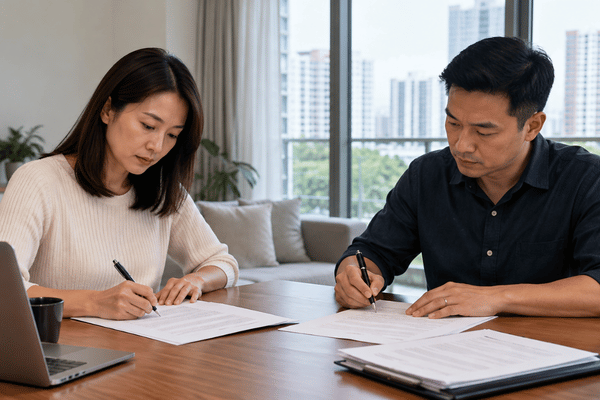
Making a divorce application is the first step in ending a marriage. Whether it is to reduce legal costs or retain greater control over the settlement, there are many reasons a person may choose to proceed without a divorce lawyer in Singapore.
In practice, filing for divorce without a lawyer is most feasible where the divorce is uncontested, meaning that both parties agree on all material issues, including arrangements for the children, maintenance, and the division of matrimonial assets.
If any of these issues are not agreed upon, the divorce will become contested. Though it is possible for an individual to legally represent himself or herself as a Litigant-in-Person in a contested divorce, the Family Justice Courts will hold the individual to the same standards as a qualified lawyer, meaning that the rules will not be relaxed in any way. Moreover, a contested divorce often involves highly technical issues such as the division of matrimonial assets and child-related matters, which require strong legal drafting and negotiation skills. As such, it is advisable to engage a lawyer in contested divorces.
This article will focus on the feasibility of proceeding without legal representation in uncontested divorces, as this is generally still a viable option for parties who desire to have a faster and more amicable settlement without having to expend significant financial resources on legal representation.
Managing an Uncontested Divorce Without Legal Representation
If parties choose to handle a divorce without lawyers, they must ensure that all the relevant paperwork is properly prepared in accordance with the requirements of the Family Justice Courts, so that the proceedings can take place smoothly. As such, both parties need to be fully aware of what is required at each stage of the proceedings.
Within 4 to 6 weeks after the requisite documents have been filed with the Family Justice Courts, the court will notify the parties of the hearing date for the uncontested divorce. In many uncontested divorces, parties are not required to attend the hearing unless directed by the Court. If the court is convinced that the parties’ marriage has irretrievably broken down, the court will grant an Interim Judgement, which is an order for divorce. If the parties have agreed on the ancillary matters, the court may record the parties’ agreement as a consent order.
The parties will only be able to extract the Final Judgement 3 months after the court grants the Interim Judgement, provided that all the ancillary matters have been resolved.
Advantages of Self-Representation in an Uncontested Divorce
Avoiding Legal Costs
There are some unavoidable expenses in divorce proceedings, such as filing fees and the cost of mandatory mediation. However, legal fees are often the most significant expense incurred in divorce proceedings. As such, choosing not to engage a lawyer can help to greatly reduce the costs involved in the divorce process.
Cutting Out Intermediaries
Choosing to proceed without lawyers could potentially speed up the divorce process, assuming that both parties can still communicate with each other for the purposes of reaching a settlement. Considerable time can be saved by eliminating the need to wait for the other party to seek legal advice and for lawyers to exchange correspondence on their clients’ behalf.
Disadvantages of Self-Representation in an Uncontested Divorce
Risk of Agreeing to Unfavourable Terms
It is possible that one party might be coerced into accepting a settlement that is unjust, whether due to an unfair division of assets or grossly inadequate maintenance payments. A lawyer can explain legal terminology and highlight unfair terms in one-sided agreements before they are signed. Where coercion is connected to family violence, threats, or harassment, a Personal Protection Order may also be relevant depending on the circumstances.
Errors and Inconsistencies in Paperwork
Though the relevant forms and templates can be found online and are publicly accessible, the documents must be filled in carefully and accurately. Delays can be caused due to missing details or mistakes in the documents, which defeats the purpose of commencing divorce proceedings without legal representation to save time and reach a settlement more quickly.
Alternative Options
Where Only One Party Engages a Lawyer
Where both parties remain on amicable terms, they may reach an understanding whereby only one party engages legal representation while the other party remains unrepresented and decides to proceed on the basis of the proposed settlement prepared by the represented party’s lawyer. Such an arrangement may arise for financial reasons, or because one party is willing to accept the proposed terms of the divorce as they are, without requesting any amendments or further negotiation.
Nevertheless, such an arrangement may be problematic. Although the terms of the agreement may appear fair and unobjectionable at first glance, there may be underlying legal or practical issues that are not readily apparent to a layperson. A lawyer can help to identify potential risks and ensure that their client’s interests are adequately protected.
Ultimately, the lawyer has a duty to act in the client’s best interests. Consequently, the unrepresented party will not receive independent legal advice and may unknowingly agree to terms that are unfavourable or fail to safeguard their long-term interests. Obtaining separate legal advice can therefore help ensure that both parties fully understand the implications of the divorce before it is finalised.
Limited Legal Advice for Reviewing Documents
Even where a party intends to conduct the divorce without legal representation, it is often worthwhile to obtain limited legal advice to review the proposed settlement before it is signed. This can help ensure that there are no hidden disadvantages, that the legal implications are understood, and that the obligations imposed on both parties are fair and reasonable. When seeking limited advice, it can also be useful to review a family lawyer’s qualifications and experience before deciding whom to consult.
Conclusion
While it is possible to complete an uncontested divorce without engaging a lawyer, doing so is generally only suitable where both parties genuinely agree on all aspects of the divorce and fully understand the legal implications of their agreement. Where there is any uncertainty, disagreement or imbalance between the parties, obtaining independent legal advice is strongly recommended.
References
SG Courts. (2026, June 1). Understand the requirements for getting a divorce. https://www.judiciary.gov.sg/family/understand-requirements-getting-divorce
SG Courts. (2026, June 1). How to file a matrimonial application for divorce (simplified track). https://www.judiciary.gov.sg/family/how-to-file-matrimonial-application-divorce-simplified-track
MSF Family Assist. (2026, August 3). Types of Divorce Proceedings. https://familyassist.msf.gov.sg/content/proceeding-with-divorce/divorce-proceedings/types-of-divorce-proceedings/#
SG Courts. (2026, March 18). At an uncontested divorce hearing. https://www.judiciary.gov.sg/family/at-uncontested-divorce-hearing
If you need help with legal matters
Have a question or need more information? Just drop us a line!
